

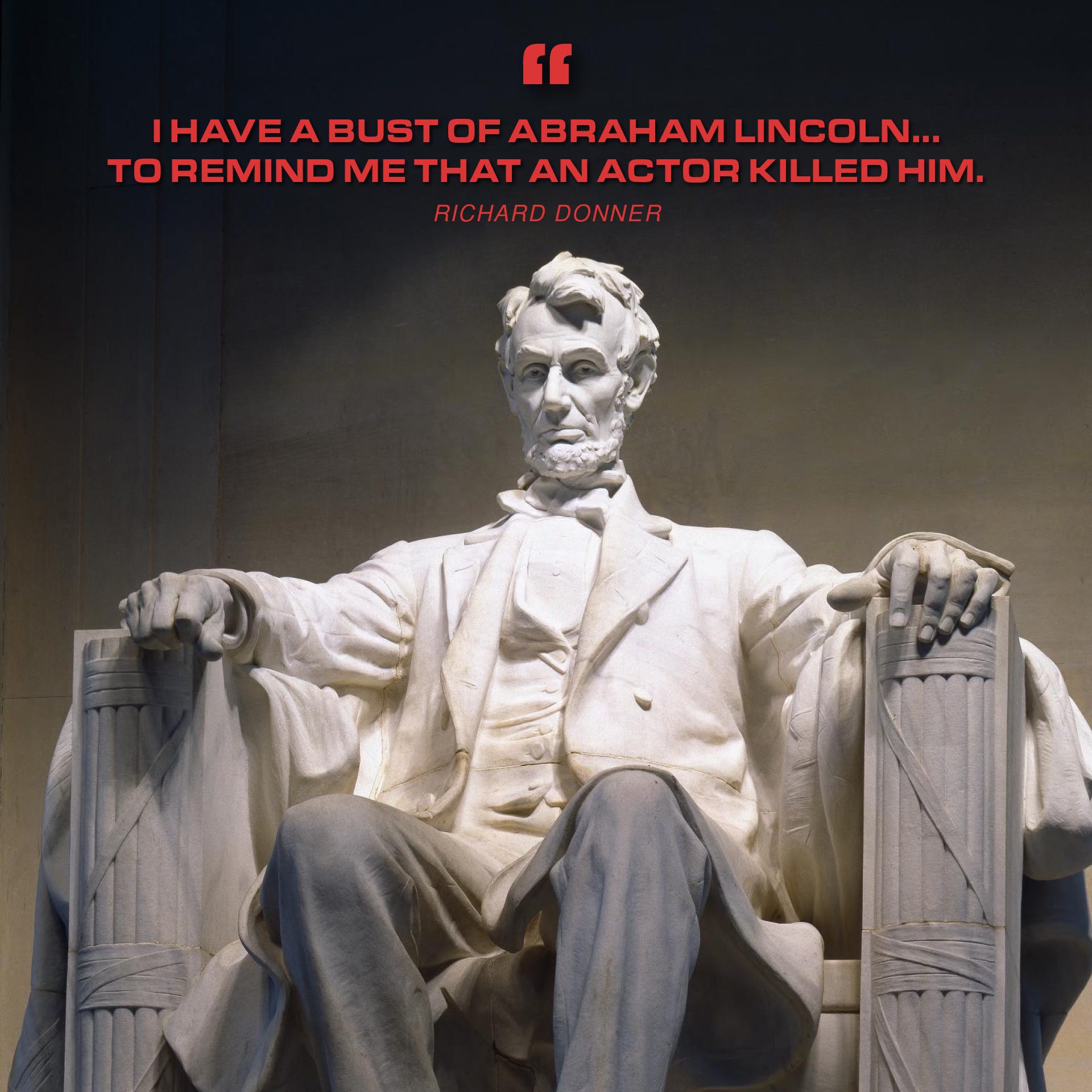
I have a bust of Abraham Lincoln...I always keep it in my office, and everybody says you have it there because he was such a great man, an emancipator. No, no, I have it there to remind me that an actor killed him. (Richard Donner, Television Academy interview)
This is a true story. Names have been omitted, mostly to protect me.
We were doing ADR with an actor (gender-neutral term). ADR, or Automated Dialogue Replacement, is when you have an actor re-record lines separately for the movie because maybe there was too much noise in the original recording, or you need them to say something else to make an edit work. YouTubers Chris and Jack have a great sketch about how it’s overused to fix plot holes in films.
No money for booking an audio booth, so I’m set up at home. Typical guerrilla filmmaking. We’re about ready to record when this actor learns something about the film’s future that they don’t like. They flip out and demand that I do as they say, or they will pull their image from the film.
“You signed a talent release,” I point out.
“I know more lawyers than you,” the actor responds. They threaten me with a lawsuit.
Then they say that if I don’t meet their demands, they will steal my script and change all the names.
In my own home, this person threatened to plagiarize me.
“I will slit throats to get ahead in this business,” this actor actually said to us, like a cartoon villain.
I was livid. But also caught off guard. I never expected anyone would tell me to my face (with witnesses present) that they were going to steal my creative work.
This incident taught me that talent releases are good, but they’re not enough. If you don’t cover all your legal bases, opportunistic people will take advantage of that opening. They’ll use that to exploit you in your own home, and then ask if anyone has any muscle relaxers. I know because it happened to me.
So, what should you do? I’m not a lawyer, so I cannot give legal advice, but I can tell you what I’d do differently If I Could Turn Back Time, and what I do now to protect myself a little bit more.
What I’d do differently
When collaborating with a group, I’d make sure that we clearly define in writing everyone’s role, their stake, who owns what, and who has deciding power over each part.
Lack of clarity basically killed the film I’m writing about. For instance, people were signing legal documents about my IP without my knowledge or consent. Now, I don’t believe everyone involved in signing those documents had nefarious intentions of cutting me out. Some of them probably thought I didn’t need to be involved. Which was naive of them because that’s certainly something I would have gone to court over.
The film became a lawsuit waiting to happen. Investors and distributors aren’t keen to risk their money on a situation that messy, especially not for a group of nobodies.
What I do now
I copyright my writing.
If I work with another writer, I make sure everyone involved signs an agreement outlining our relationship. Is it a collaboration agreement where everything is evenly split, or is it a work-for-hire situation (like Real American)?
I document conversations about my projects. I keep journals where I record who I spoke to, what about, and when, during or immediately after the conversation. This is something I started doing right after I was threatened. Once again, I am not a lawyer, but I am going to cite Federal Rules of Evidence Rule 803. Exceptions to the Rule Against Hearsay:
(5) Recorded Recollection. A record that:
(A) is on a matter the witness once knew about but now cannot recall well enough to testify fully and accurately;
(B) was made or adopted by the witness when the matter was fresh in the witness’s memory; and
(C) accurately reflects the witness’s knowledge.
If admitted, the record may be read into evidence but may be received as an exhibit only if offered by an adverse party.
I keep a diary in case it comes in handy for me one day. But again, I’m not a lawyer, so I can’t speak to whether that’s admissible or whether it’d be considered strong evidence.
For years, I’ve avoided sharing the details of this story because I was worried about retaliation. Plus, I was worried it’d be perceived as gossip. But I decided to share this as a cautionary tale for filmmakers. You can never be too safe with this stuff. Even if you’re just a bunch of friends making movies with no money, all it takes is one person to start seeing dollar signs, and everything turns radioactive. It can kill a film’s future.
But hey, remember that YouTube sketch I talked about at the beginning? Check it out because we need a laugh after all that: